One goal, many solutions: A patient’s view on ISOLS
By Stéphanie Anzellotti
Recently I attended an international conference on limb-saving surgery, held in Vienna at the end of September. Specialists from all over the world came together with one shared goal: saving the arm or leg of someone with a bone or soft tissue sarcoma, rather than amputating it. The conference programme was so extensive that I hardly knew where to start. I am not a specialist, but a patient advocate and mother of a child with osteosarcoma. In this blog, I am sharing what I saw and heard, and what I am taking home with me.
ISOLS stands for the International Society of Limb Salvage. It brings together specialised surgeons who remove tumours (or severe injuries or infections) from bone and tissue. They then reconstruct the limb as well as possible, using an implant inside the body, the patient’s own bone or bone from a donor. They meet to share their knowledge so that more patients worldwide may be offered a real alternative to amputation.
I mainly chose sessions on bone sarcoma which covered osteosarcoma, but also Ewing sarcoma and chondrosarcoma. I also attended sessions on reconstruction with the patient’s own or donor bone, on metastatic disease, on mega-prostheses and on metal ions: tiny metal particles that can be released from an implant. And, of course, the sessions on children and young adults.
Amputation: rare today, but never the easy way out
The word amputation provokes strong reactions. It used to be the standard treatment for a sarcoma in the arm or leg, and in some low-income countries or war zones it still is. In Europe, it now happens only rarely.
But amputation is never a choice of convenience. The most important rule in treating a sarcoma is that the tumour must be removed completely, together with a layer of healthy tissue around it. Doctors call this “clear margins” meaning that there are no cancer cells left at the edge of the removed tissue. This greatly reduces the chance that the sarcoma comes back.
Sometimes a tumour is very large, or lies right against important nerves, blood vessels or muscles. To still achieve a safe margin, the surgeon then must remove those as well. Little or nothing is left of the limb’s function. In that case amputation may be the only way to remove the tumour safely. Such a decision is never taken lightly. It is always preceded by extensive discussion between different specialists, the patient and parents or guardians where relevant.
How amputation became the exception (though not everywhere)
From the 1970s onwards, treatment changed thanks to three breakthroughs:
- Multi-drug chemotherapy. Combining different anti-cancer drugs has greatly improved the chance of survival by controlling the tumour prior to surgery and after surgery to kill off any tumour tissue left behind.
- Better imaging. Magnetic Resonance Imaging (MRI) and Computer tomography (CT) scans show surgeons exactly where the tumour is beforehand, so they can plan the operation precisely.
- New ways to reconstruct bone, such as custom-made implants and bone grafts.
A turning point came in 1986. A large retrospective study[1] showed that patients with osteosarcoma of the thigh bone who also received chemotherapy had the same chance of survival after limb-saving surgery as after amputation.[2]
One goal, different solutions
What I learned is that not every country approaches reconstruction after a bone tumour surgery in the same way. That applies to arms and legs, but also to the hip, the sacrum and the spine. Once the tumour has been removed, there are roughly three options:
- a mega-prosthesis[3]: a large metal implant that replaces a section of bone and often the joint as well;
- donor bone: bone from a deceased donor, stored in a bone bank;
- the patient’s own bone: for example, a piece of the fibula (calf bone) with its own blood vessels, or the removed bone itself. That bone is then treated outside the body with radiotherapy to kill the cancer cells and put back.
As one speaker explained, a country’s choice is not determined by medical considerations alone:
- Culture and religion. How people view the body after death partly determines how many donors there are. In some traditions, the body is seen as a gift from one’s parents that should remain intact, which leads to a shortage of donors.
- Infrastructure. Working with donor bone requires an experienced team, a high volume of patients and a reliable, modern bone bank. Without such a bank, it simply is not feasible in practice.
- Cost and reimbursement. A mega-prosthesis is expensive. In countries with fewer resources, doctors therefore more often opt for the patient’s own bone or donor bone. The choice is also influenced by what health insurance covers.
- Techniques often remain linked to the place where they were developed. Japan for example is known for freezing the patient’s own bone, India for irradiating it outside the body, and Argentina and Spain for working with donor bone.
 Children and young adults: survival is not the finish line
The sessions on children, teenagers and young adults touched me the most. As an osteosarcoma mum, this hits very close to home.
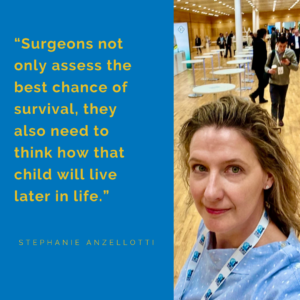
Surgeons do not only have to assess what gives the best chance of survival. They also need to think about how that child will live later in life with the treatment they received. Saving or amputating a leg is not the end of the journey. Good follow-up remains necessary, physically and emotionally, even many years later.[4]
Surgeons at the conference considered rehabilitation and mental support part of a successful treatment pathway. They also highlighted the value of long-term follow-up on the effects of chemotherapy or psychological impact of a cancer diagnosis.
What I take home
Do highly technical and medical sessions really add value for a patient advocate? I believe they do. The better I understand the complexity behind treatment decisions, the better I understand the questions patients and families are faced with. I don’t need to become the medical expert in the room. But understanding more helps me ask better questions, follow the discussions more closely and share relevant insights with our patient community.
Some of the most interesting learning happened in the discussions after the presentations, where surgeons debated their techniques and choices with each other: which technique suits which patient? One thing became very clear: expertise makes the difference.
For me, these were valuable few days of listening, learning and connecting.
Notes:
[1] Simon MA, Aschliman MA, Thomas N, Mankin HJ. Limb-salvage treatment versus amputation for osteosarcoma of the distal end of the femur. J Bone Joint Surg Am. 1986;68(9):1331-7. https://pubmed.ncbi.nlm.nih.gov/3465732/
[2] Note from the editorial team: Limb-saving surgery is a valuable array of techniques to avoid amputation, but it can carry the need for long term care. Amputation can also be curative, carries its own range of long-term side effects, and it also requires lifetime care with prosthetics and practical support.
[3] Note from the editorial team: This is also known as an endo prosthesis. It can also replace a complete bone.
[4] Note from the editorial team: There are important issues of fertility preservation (in teenage patients), lengthening artificial bones in children as they grow, chemotherapy long term effects (which differ with different chemo combinations), and the opportunity to take part in clinical trials and scientific research which patients in some countries have.
Credits: Photos provided by Stéphanie Anzellotti to SPAGN for publication
Bio:
Stéphanie Anzellotti is a patient advocate with Cum Cura in Belgium. Her son was diagnosed with osteosarcoma four years ago, and his journey from diagnosis to control was well organized. But when talking to other patients and parents, Stéphanie was sobered by the fact that – for many different reasons – pathways are far from ideal. This is why she is committed to help improving that.