Every patient matters: Building the future of synovial sarcoma research
By Julie Kramer
 When you or your child gets diagnosed with an ultra-rare cancer[i], the first place you’re headed is typically the internet to find out what it even is, and you quickly learn that search engines have limits.
There are only so many published studies. Only so many patient stories. Only so many answers. Yet that uncertainty doesn’t stop you from searching.
I found myself doing exactly the same thing, following my own stage IV synovial sarcoma[ii] diagnosis in 2014 - when I was just 23 years old. I asked my parents to bring me my laptop to the hospital because I needed to understand everything I could about the disease that had suddenly changed my life.
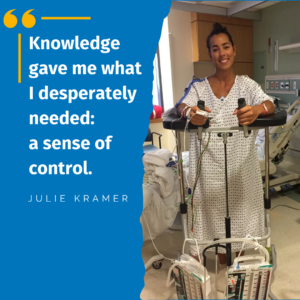
Night after night, I read every study I could find, searched for clinical trials, and learned medical terminology I never imagined I would know. I wanted every piece of information, even when it was frightening, because knowledge gave me something I desperately needed: a sense of control.
Lack of data is the bottleneck
After all that searching, I discovered it’s not that there wasn’t good science, there just simply wasn’t enough of it. From the patient data I did find, there was only one case study that matched closest to my description of a patient that had since passed. There were little to no clinical trials available, scattered medical records, data and tumor tissue sitting in institutions rather than being studied collectively, and researchers and oncologists unable to answer important questions because the data did not exist. Without a centralized resource, research progress is limited. Research of rare diseases doesn’t suffer from lack of brilliant scientists, it suffers from a lack of data.
Building what didn’t exist
Rather than asking why data didn’t exist, the Synovial Sarcoma Foundation set out to build it. Established in 2022 by Laura and Chas Spence after their 16-year-old son Callan had been diagnosed with synovial sarcoma, the Foundation’s mission is to drive innovation and advance research for this rare and aggressive cancer.
With an initial funding of $1 million the Foundation collaborated with the Children’s Hospital of Philadelphia (CHOP) and Penn Medicine to establish in 2023 the first-of-its-kind Synovial Sarcoma Biorepository and Registry Program. The registry gathers prospective patient data by collecting the necessary blood specimens and imaging at each patient’s routine maintenance scan. Tumor tissue is collected in different forms, prioritizing flash frozen tissue taken immediately after surgery. That tissue is then used in a mouse model to test target therapies and tumor recurrence. To date, the foundation-funded coordination team at CHOP has collected the following:
- 150+ patient’s clinical data
- 100+ blood samples
- 2,500 imaging studies
- 50+ biospecimens.
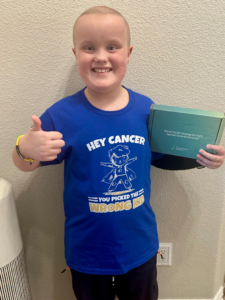
Jonathan, 9 years, with a welcome kit for registrants of the biorepository. He says: "My tumor can help find a cure? That's awesome!"
Turning patient data into discovery
The purpose of the biorepository is to accelerate research that leads to better treatments and improved outcomes for patients with synovial sarcoma by providing researchers with high-quality clinical data and biospecimens. Researchers need to be able to understand whether the tumor microenvironment can be manipulated for new therapies, how tumors change under treatment and develop drug resistance, how to properly diagnose synovial sarcoma early on, and how to better categorize synovial sarcoma at diagnosis.
Collaboration changes rare
In rare cancers, no single institution sees enough patients to answer every research question. Collaboration isn’t just beneficial, it is essential. Before the Synovial Sarcoma Biorepository, there was no centralized resource where researchers could access comprehensive synovial sarcoma data and biospecimens. That barrier has since been removed. Academic and industry researchers can request access to data and samples, while the Foundation's dedicated PhD Research Director integrates external datasets and develops research questions that turn individual patient contributions into discoveries that benefit the entire community.
Helping patients become partners In research
I joined the Synovial Sarcoma Foundation seven months ago, but I have spent the last twelve years living the reason this work matters. As a three-time Stage IV synovial sarcoma survivor and now a nine-year NED[iii] survivor, I know firsthand what it feels like to search for answers that don't exist. Today, one of the greatest privileges of my work is helping patients transform that uncertainty into action.
The challenges we still face
One of our greatest challenges, and one of the most critical to advancing research, is obtaining fresh tumor tissue. Too often, patients undergo what are known as "oops surgeries," where a tumor is removed under the assumption that it is a benign cyst or mass. It is only after surgery, when the tissue is analyzed by a pathologist, that a diagnosis of synovial sarcoma is made. These cases highlight one of the very problems we are working to solve: delayed or incorrect diagnosis. By collecting tumor tissue and clinical data, we can help researchers better understand this disease and, ultimately, improve how it is recognized and treated.
Another challenge is helping patients understand just how simple their participation can be and how invaluable it is. Many people don't realize that by contributing their medical records, tissue, blood samples, or clinical information, they are providing researchers with the foundation needed to make new discoveries. Every patient who participates strengthens this resource, bringing us one step closer to better treatments and, ultimately, a cure.
Every patient matters
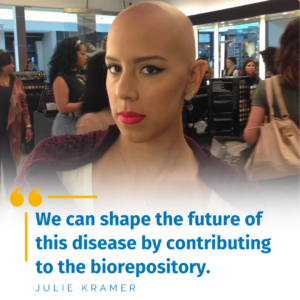 Every patient worldwide who has ever received a synovial sarcoma diagnosis is eligible to participate in the biorepository. While fresh tumor tissue is incredibly valuable for advancing research, it is not required.
We recognize that not every patient undergoes surgery or has tissue available to contribute—but every diagnosis matters, every experience matters, and every patient could make an impact.
The patients we have lost deserve this commitment from all of us. The patients fighting today deserve the opportunity to shape the future of this disease. And future patients deserve the progress that can only come from the collective contributions of our community.
We hope to expand access to clinical trials and genomic studies, open additional enrollment centers, including international sites, integrate retrospective data from other institutions, and accelerate precision medicine through Foundation-funded research.
An award that belongs to the community
Receiving SPAGN’s Advocacy in Action Award is an incredible honor and a testament to what patient communities can accomplish when they come together through the same passion for making a difference and refuse to accept “rare” as a reason for slow progress.
Every patient who joins the synovial sarcoma biorepository moves research one step closer to the answers every newly diagnosed family desperately searches for. Every blood sample tells a story. Every medical record fills another gap. Research does not exist without patients. Every breakthrough begins with someone choosing to participate. If we want better treatments, earlier answers, and ultimately a cure, we must build the research together.
Patients are desperate for a story of hope; this registry can provide a lifetime of hope.
i) Ultra-rare sarcomas were defined as those with an incidence of approximately ≤1 per 1,000,000, to include those entities whose rarity renders them extremely difficult to conduct well powered, prospective clinical studies. Source: https://pmc.ncbi.nlm.nih.gov/articles/PMC8319065/
ii) Synovial sarcoma develops in cells around joints and tendons. Synovial sarcoma can occur anywhere throughout the body but often near the knee. Synovial sarcoma is most commonly associated with young adults. Source: https://www.sarcoma-patients.org/soft-tissue-sarcoma-subtypes/
iii) No Evidence of Disease (NED)
Credits: Cover photo by Uli Deck for SPAGN. Other photos provided by Synovial Sarcoma Foundation/Julie Kramer for publication by SPAGN.
Bio:
Julie Kramer is the Community Engagement & Partnerships Manager at the Synovial Sarcoma Foundation. A three-time Stage IV synovial sarcoma survivor, Julie was diagnosed in 2014 and has been No Evidence of Disease (NED) since 2017 following treatment for her third recurrence. Her personal experience fuels her passion for patient advocacy, empowering others facing a rare cancer diagnosis, and advancing research that will improve outcomes for future patients.