From listening to action: Patients’ voices are shaping sarcoma care in Italy
By Martina Gherlinzoni
When we launched the project[i], we had a simple but ambitious goal: not just to listen to patients and caregivers, but to turn their experiences into real change. Too often, people living with rare cancers face challenges that remain invisible to healthcare systems and policymakers. We wanted to change that. Our aim was to transform the everyday experiences of sarcoma patients and their families into practical recommendations that could improve care across Italy. Rather than creating a list of wishes, we set out to build a roadmap for action.
 Building change through 3 steps
The project was built around three key pillars: listening, analysis, and action.
- First, we listened. We launched the first nationwide survey in Italy dedicated specifically to sarcoma patients and caregivers.
- Second, we analyzed the results. The insights collected through the survey became the foundation of the first “Italian Sarcoma White Paper”, a document designed to identify challenges, highlight gaps in care, and propose solutions.
- Third, we acted. The White Paper was presented at the Chamber of Deputies in Rome and shared with patient organizations, healthcare professionals, researchers, and policymakers across the country.
This three-step approach is one of the project's greatest strengths because it can be replicated for other rare diseases and in other countries.
Giving sarcoma patients a voice
The journey began with the national survey "Living with Sarcoma in Italy", the first initiative of its kind in the country. The survey was designed to capture the real experiences of patients and caregivers across four areas:
- Daily challenges and unmet needs
- Diagnostic and treatment journeys
- Access to information and psychosocial support
- Priorities for future research
The findings revealed important challenges. One of the most striking results was that almost half of respondents reported having received an incorrect or incomplete diagnosis before obtaining the correct one. This highlights the need for greater awareness, earlier recognition, and improved referral pathways for sarcoma patients.
The first Italian Sarcoma White Paper

Screenshot
The survey results became the foundation of the Italian Sarcoma White Paper, the first document of its kind ever published in Italy. The White Paper was designed to bring together different perspectives and create a shared vision for improving sarcoma care. It is divided into three sections:
The first section presents the voices of patients and caregivers through both quantitative data and personal experiences. The second section provides expert perspectives from leading Italian sarcoma specialists. It explores the different types of sarcoma, current epidemiological trends, and the specific needs of children, adolescents, and patients affected by rarer subtypes such as uterine sarcomas. This section also examines research priorities, the role patients can play in clinical and translational research, and the importance of psycho-oncology in supporting people throughout their care journey.
A particular focus is placed on specialist centres and healthcare networks.
Drawing on international experience and the consensus paper of SPAGN on Sarcoma Intelligent Specialist Network, the document highlights the value of specialist networks in ensuring that patients receive timely and appropriate care. Our goal was not only to advise policymakers but also to provide accessible information for healthcare professionals who may not be sarcoma experts.
From evidence to recommendations
The third and final section is where the Italian Sarcoma White Paper moves from analysis to action. Using both survey findings and consultations with patient organizations, clinicians, and researchers, we identified the most important challenges facing the sarcoma community and propose 14 recommendations for improvement. These recommendations cover a wide range of areas, including:
- Improving diagnostic accuracy
- Expanding access to molecular testing
- Strengthening specialist centers and referral networks
- Integrating psychosocial support into routine care
- Increasing investment in research
- Promoting patient involvement in healthcare governance
Most importantly, the White Paper was not written about patients. It was built from patients' experiences and designed to help create meaningful system-level change. The document also includes clear infographics explaining sarcoma types and mapping specialist centers across Italy where patients can seek expert care.
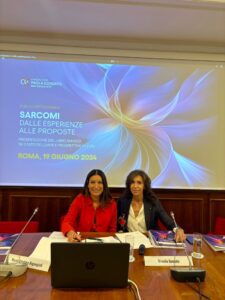 Official presentation of the Italian Sarcoma White Paper by Ornella Gonzato and Maria Cristina Bigongiali, journalist and TV anchor, at the Chamber of Deputies in Rome
Bringing sarcoma to the national agenda
A key milestone was the official presentation of the Sarcoma White Paper at the Chamber of Deputies in Rome on 19 June 2024. The event received support from national institutions, including a message from the President of the Council of Ministers and the patronage of the Ministry of University and Research.
Presenting the White Paper in Parliament was more than a symbolic moment. It helped bring sarcoma care into the national policy conversation and ensured that the needs of patients received attention at the highest institutional level. The launch was followed by a national press conference and extensive media coverage across newspapers, television networks, and news agencies. Overall, the campaign reached an estimated audience of almost 47 million people. For perhaps the first time, sarcomas became a major national news topic in Italy.
Turning recommendations into reality
The project did not end with the publication. The survey was launched in June 2023, and the White Paper was presented in June 2024. Since then, work has focused on implementation. From the beginning, the Italian Sarcoma White Paper[ii] was intended to be a living document - one that would guide ongoing action rather than remain on a shelf. Today, several initiatives are underway to translate its recommendations into practical improvements.
A participatory model to learn from
 This project demonstrates that it is possible to bring a rare cancer from relative invisibility to the center of a national healthcare discussion. It represents the first structured, policy-oriented initiative of its kind focused on sarcoma in Italy. More importantly, it offers a model of participatory governance in which patients, clinicians, researchers, and institutions work together to identify problems and develop solutions.
The experience has also highlighted the challenges involved in creating change. Coordinating a national initiative requires long-term commitment, careful planning, and collaboration among many stakeholders with different priorities and perspectives. Yet, these challenges also reinforce the value of the approach. By listening to patients, translating their experiences into evidence, and using that evidence to drive action, it is possible to create a stronger and more responsive healthcare system.
We believe this model can be replicated for other rare diseases and in other countries. Because meaningful change begins with listening - but it only happens when listening is followed by action.
[i] For more details about the Advocacy in Action Award: https://www.sarcoma-patients.org/advocacy-in-action-award-2/
[ii] To receive a copy of the Italian Sarcoma White Paper: https://www.retesarcoma.it/sarcomi-dalle-esperienze-alle-proposte-libro-bianco-su-stato-dell-arte-e-prospettive-future
Credits: Cover photo by Uli Deck for SPAGN. Other photo provided by Pete Sarcoma for publication by SPAGN.
Bio:
Martina Gherlinzoni is a member of the Board of Directors of the Fondazione Paola Gonzato-Rete Sarcoma ETS, the leading Italian sarcoma patient advocacy organization founded by Ornella Gonzato, in memory of her sister Paola. Martina holds a law degree and is currently completing dual traineeships in notarial practice and litigation. As Paola's niece, she contributes to the work of Rete Sarcoma with both professional commitment and a strong personal connection to its mission.