By bike from Berlin to the Taj Mahal: Young Ewing sarcoma survivor starts charity tour
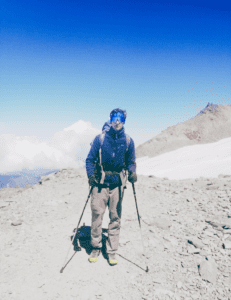
2021: John on top of the Mont Blanc
Voices of Sarcoma: John, on May 8th you are starting a charity cycling tour from Berlin to the Taj Mahal. Your tour is called "Survival is not enough." Why?
John Müller: First of all: I want to show that cancer doesn't have to mean the end. I spent ten months in hospital and saw how differently cancer patients deal with their diagnosis. Some see it as the end of the line. Others don't give up courage and always see the light at the end of the tunnel.
Secondly, I realized that when you have survived, it's not at all a given that you quickly find your way back into life. And it became clear to me that you can still take your dreams into your own hands and try to grasp and realize them — perhaps in a different way.
My dream, even eight years ago, was to cycle to India. But when the cancer came, I no longer thought I would ever be able to do that, because there were obviously very different things on my mind. A sick person has only one single dream, and that is to get well again. And that's exactly how I felt. But then I thought: 22 years old — that cannot be the end. I asked myself: "What did I actually want originally? What drives me? What makes me happy?"
Voices of Sarcoma: What were your answers?
John Müller: I told myself: if I make it out of the hospital alive, I want to give something back. And that I want to fulfil my dream of a cycling trip to India — but now with a completely different mission: to ride for those who currently can't.
Voices of Sarcoma: Your charity tour is dedicated to young cancer patients who, like you, have or had an Ewing sarcoma. What does this diagnosis mean for a young person?
John Müller: When the biopsy was done and I was on the oncology ward for the first time, I was convinced it was only temporary. I had always done a lot of sport, never smoked. But then they said: "Ewing sarcoma." I had never heard that word in my life before. They talked about at least 14 chemotherapy cycles. I was crying. How was I supposed to manage that? But we could not lose any time. From one day to the next the treatment started. Ewing sarcomas are very rare and aggressive. There are perhaps 100 new diagnoses of Ewing sarcoma in Germany, and only a quarter of those in the trunk of the body, as in my case.
Voices of Sarcoma: How did you notice it?
John Müller: The tumour was pressing on a nerve — it was extremely painful. I went to the emergency room, and my greatest stroke of luck was ending up directly at the sarcoma centre in Stuttgart. I was treated there for ten months, and I have been free of recurrence and metastases for over two years.
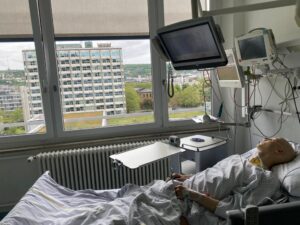
2022: John spends ten months in the clinic
Voices of Sarcoma: What were the factors in your treatment that helped you?
John Müller: I was a test patient in a new study from the USA — I don't know how it would have turned out otherwise. With such rare diseases, I think it's important to be open to studies — also because it's the only way that better treatments can be developed for patients in the future. You should also be open to the opinion of sarcoma specialists — in my case we asked also second opinions from other clinics.
Another important factor for me was exercise — in a reduced form, as much as was possible. Just after one week of bed rest, you lose already 25% of your leg strength. Even the smallest everyday movements help: getting your own water, walking to the hallway, doing a lap around the block.
Voices of Sarcoma: What did the illness mean for you professionally and financially?
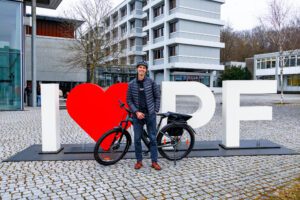
2026: John prepares for cycling through 15 countries
John Müller: At the time I was still in the middle of my studies and doing an internship. But from one day to the next, I no longer received any internship pay, no unemployment benefit, and was in no way financially covered for a certain period. There you are with such a serious diagnosis, receiving chemotherapy, and not knowing how you're going to pay next month's rent. That made me realize how many people fall through the cracks, regardless of age, when they receive a cancer diagnosis — possibly worse when there's also a language barrier, or when their memory isn't functioning properly. Or when they are young. It became clear to me that sometimes 200 or 300 euros can make an enormous difference in these situations.
Regarding my studies, I didn't know at first how things would continue. I didn't want to give up entirely. Thanks to a few wonderful professors, I completed some online courses and finished my degree in International Business Management. I then applied from the hospital for a job in the start-up investment division of a large company — and got it. But in February I left that position to focus entirely on the charity tour.
Voices of Sarcoma: Please tell us more about the tour.
John Müller: It starts on May 8th at 8:30 a.m. in Berlin. I hope we can mobilize at least 100 cyclists there — from folding bikes to racing bikes and scooters. Everyone is most warmly welcome to join and set a sign together for young people with cancer. I will be passing through 15 countries in 80 days, and hopefully we can mobilize cyclists and sarcoma patients along the way. Everyone can follow my exact route on the website 8000km.live. I will be filming myself and, whenever there is internet access, posting updates on Instagram.
Voices of Sarcoma: You will be traveling alone. What kind of support are you hoping for during the journey?
John Müller: I would love it if, as I pass through Bratislava, Budapest, Belgrade or Sofia, there are contacts and meeting points available. For example, local cycling communities or cancer communities with whom I could ride a short stretch together. Or we meet in the morning for a coffee and a photo to document it and simply to say: we are thinking right now of those who are in hospital and not doing well. I would also like to visit sarcoma centres or oncology wards. The cancer diagnosis is the same everywhere, but how do different countries deal with it? And of course, accommodation options or media contacts would also be helpful.
Voices of Sarcoma: You have already raised more than 21,000 euros, and hopefully there will be more. Who or what would you like to support with this?
John Müller: My primary idea is for the funds to serve as an emergency fund for young cancer patients. I am in contact with sarcoma centres throughout Germany, but also with the Children Cancer Foundation, the German Sarcoma Foundation, and the association Ultra Rare Sarcoma. A dedicated donation account has been set up in cooperation with the Foundation for University Medicine of Essen. We want to provide immediate financial assistance for patients in need, but also support research projects for sarcomas with very low incidence rates. There is so much hardship surrounding sarcoma. It is also specifically intended for adolescents and young adults, because I noticed that they often fall through the cracks.
Voices of Sarcoma: Thank you very much for the conversation. We wish you all the best and much success with your charity tour.
Credits: Cover photo by Tobi Grosser, Klinikum Stuttgart; John with a bike by Susanne Materac, Hochschule Pforzheim; Private photos of John on top of the Mont Blanc and in the hospital were provided by John Müller to SPAGN for publication.
Gabi Ott (SPAGN) interviewed John Müller on 15 April 2026 for the Voices of Sarcoma blog.
Bio:
John Müller, 26 years, Ewing sarcoma survivor, adventure athlete, activist and deeply rooted in the German start-up ecosystem.
Would be happy to be a part if you are in Mumbai.Please let me know te dates